Offers To Receive
The invisible numbers behind Bafana's historic group stage

Bafana Bafana beat South Korea 1-0 in their final Group A game of the World Cup, to ensure safe passage into the knockout rounds. With Czechia losing to Mexico at the same time, the two results combined mean Bafana finish 2nd ion their group for the first time ever. Additionally, there are no 3rd place permutations to worry about - it’s straight to face Canada on Sunday evening.
In their benevolence, FIFA are releasing some free detailed data reports after every game through their Training Centre. In addition to what traditional data providers like Opta and Statsbomb would provide, FIFA have their unique metrics too. One of these, which we’ll explore in this piece is offers to receive. Unlike passes, tackles, interceptions which are on-the-ball events, this is an off-the-ball metric. What players do without the ball, or in anticipation of receiving it, provides a new layer of analysis and insight.
Offering to receive
“Offering to receive refers to the actions a player makes off the ball when their team are in possession. More specifically, the concept relates to whether the player’s intention is to receive the ball from a team-mate and continue or complete the possession phase.”
You will remember this from Matchday 1? (Inside voice: Of course, I do..)
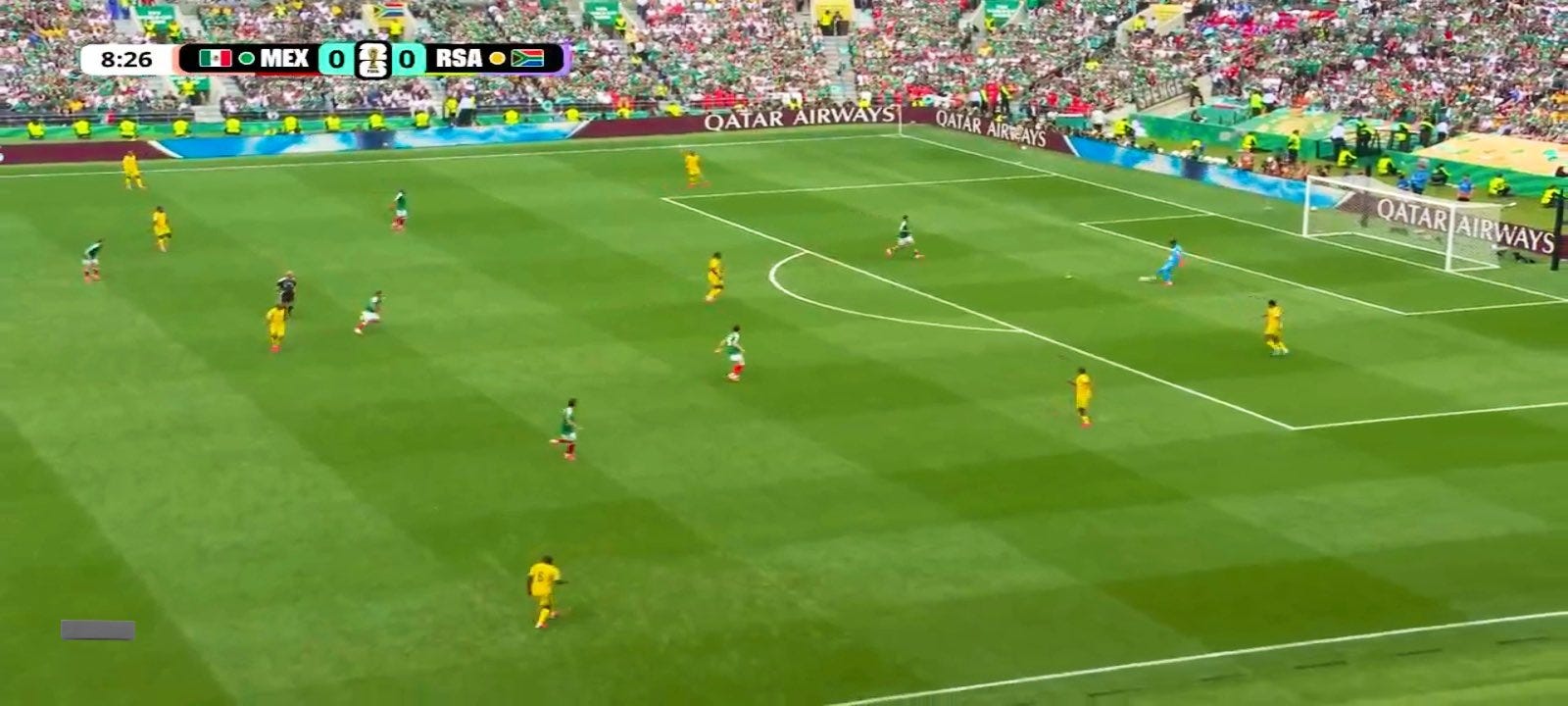
Sithole requested the ball to feet from Williams, signalling for a pass. This was a deliberate action made in an attempt to receive possession. The hand signals were clear and obvious - give me the ball. Williams obliged, only for Sithole to be hassled off possession for Mexico’s opening goal. Regardless of what happened after, this qualifies as an offer to receive the ball.
Looking at offers to receive across the three Bafana games gives us a better understanding of how Bafana have approached each fixture - and “offers” us a glimpse of how Hugo Broos tried to control Bafana’s possession phases.
Game 1: Bafana 0-2 Mexico (11 June)
A frustrating performance and result. From the lineup, it was clear Bafana had opted for a conservative approach. The early goal, and two red cards did not help matters, and the numbers should be read with that context in mind. That said, Bafana made 247 total offers to receive the ball, with 29% of these in the defensive third. This was the game with the highest proportion of offers made so deep.
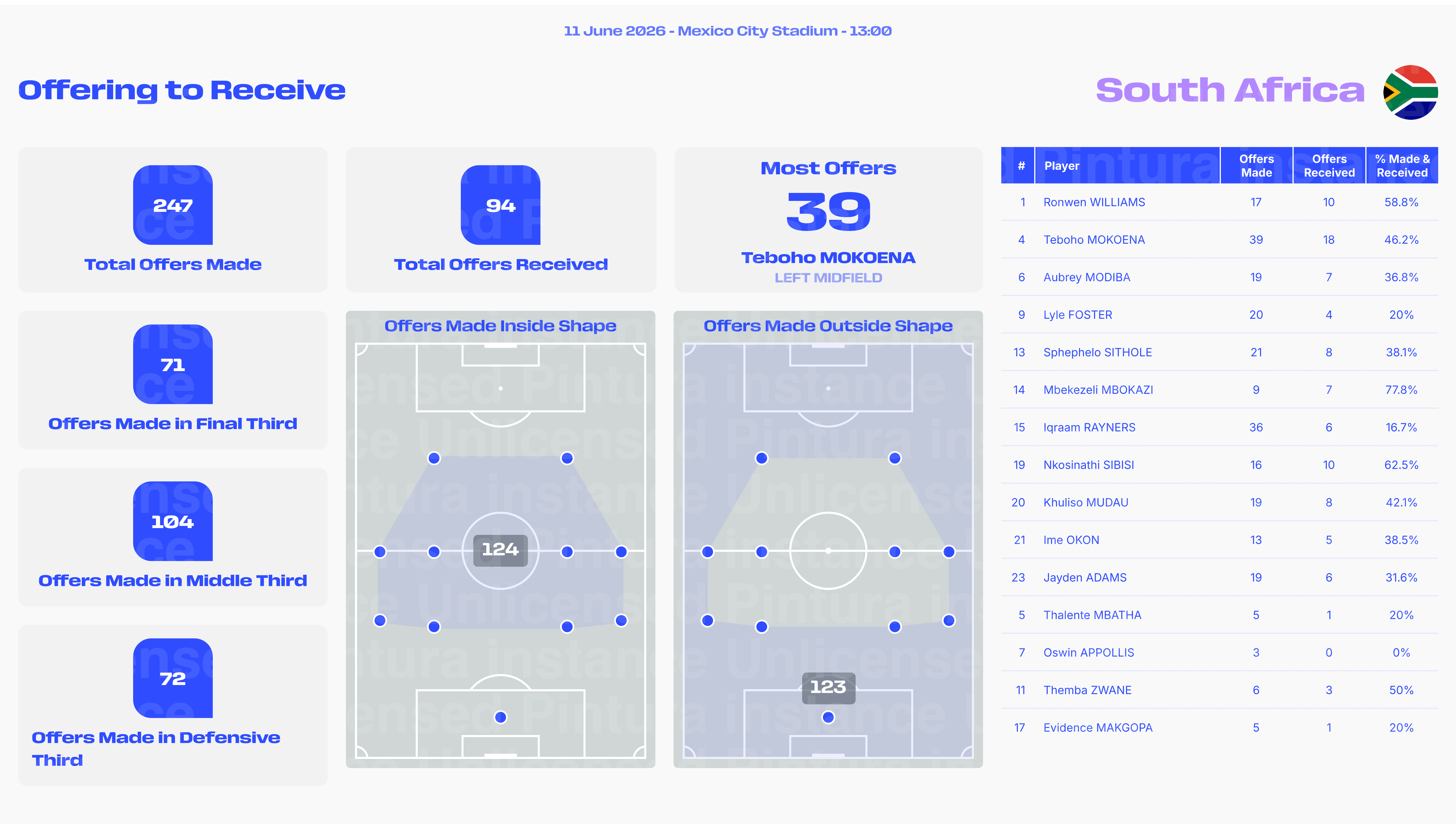
On a player level, Teboho Mokoena made the most offers to receive the ball, with Rayners second - another reflection of a creative-midfielder-less build up that never quite clicked. It was a tactical approach that did not pay off, yet it was only the first of three games and provided valuable lessons for all.
Game 2: Czechia 1-1 Bafana (18 June)
Bafana’s most possession-heavy game on the group stage (60% possession compared to 36% in MD1) - maybe an overcorrection, but one that paid off late on. They conceded another early goal, but this time had the personnel to play more of a possession-based game. The positive correlation between ball possession and offers is clear here. Bafana made 472 offers, nearly twice as many as the Mexico game (compared to 261 for Czechia).
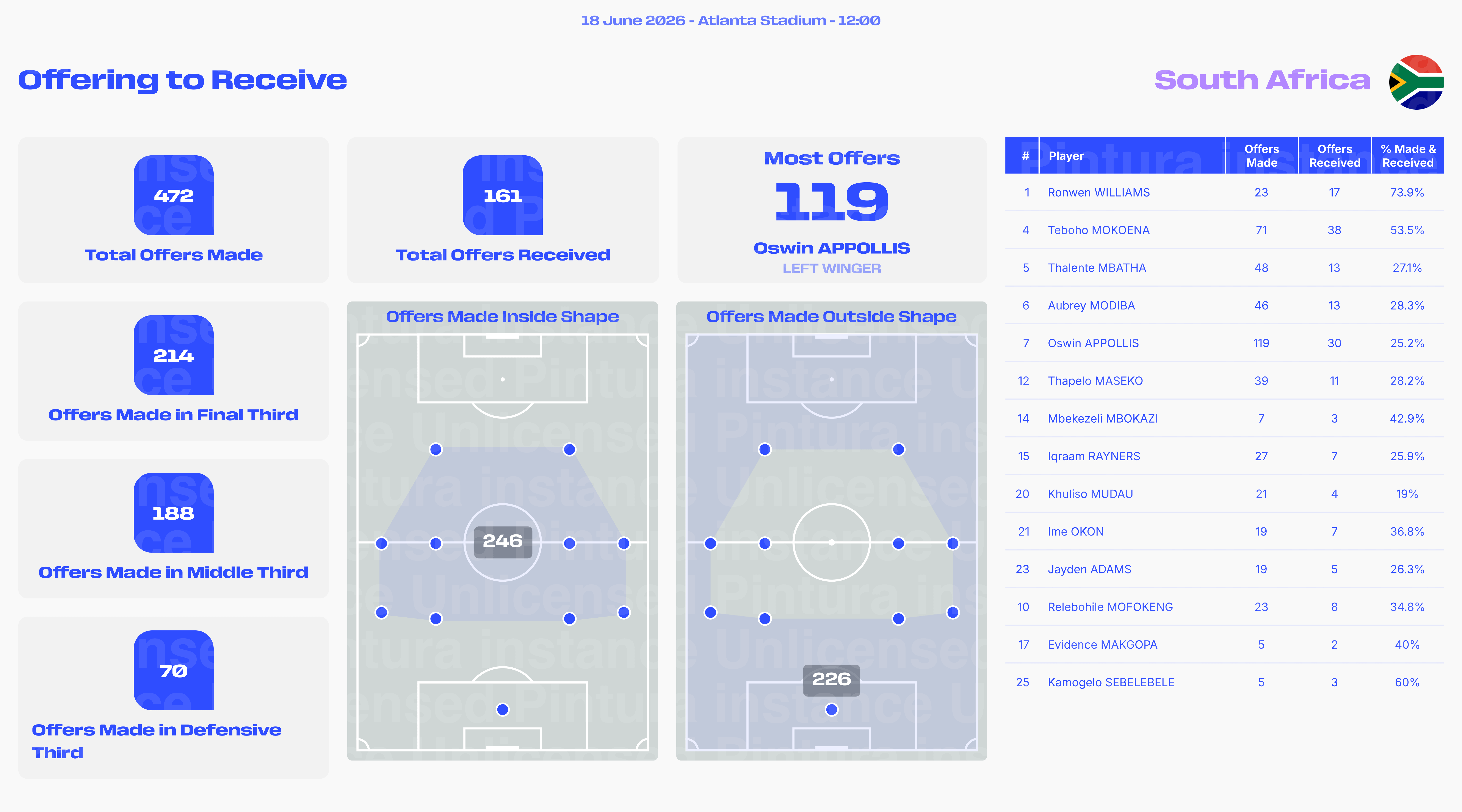
Oswin Appollis made an incredible 119 offers, comfortably the most of any player on the field. Although he only received 30, this clearly demonstrated a different approach - offers still help create space and open up passing options between defensive lines. Indeed, 45% of offers to receive were made in the final third, the highest such proportion in our three games - Czechia’s reluctance to attack also helped.
Game 3: Bafana 1-0 South Korea (24 June)
The win over South Korea was enjoyable on many fronts. I chose the sleep five hours and wake-up-to-watch approach instead of the stay-up-all-night approach. My confidence in getting the win (on-the-field and against sleep) increased as the first half played on. Bafana maintained 31% possession in this win, their lowest % in any of the 12 World Cup games played since 1998. Correspondingly, only 189 offers were made by Bafana in this game.
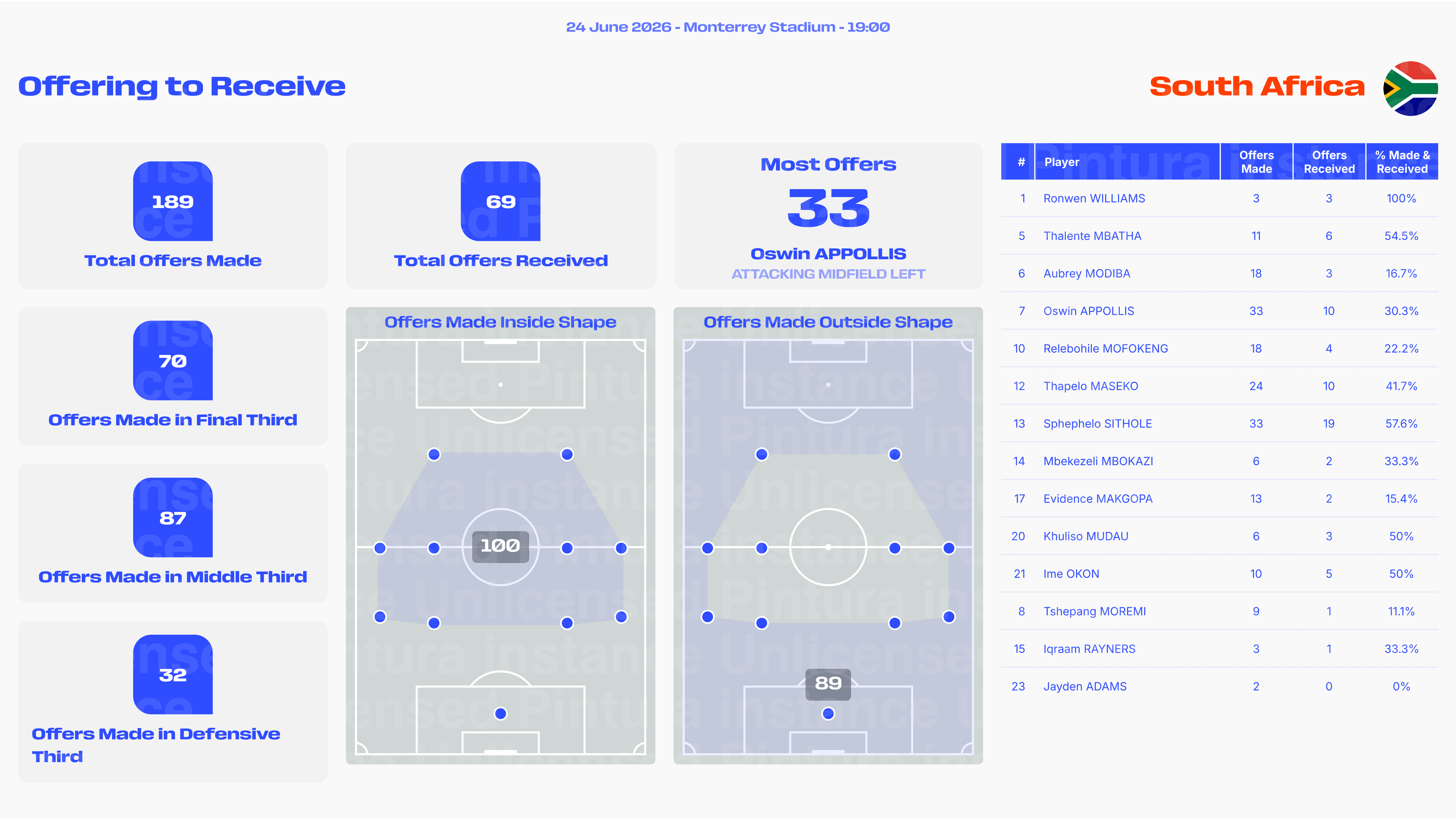
Again, Oswin Appollis led the way (joint with Sphephelo Sithole) and another attacker Evidence Makgopa in third. While their possession figures mirrored MD1, Bafana showed a more direct approach when they had the ball. Ronwen Williams went long regularly, attempting the most line breaking passes among Bafana players (26). Against Czechia, that responsibility had fell to Teboho Mokoena (32), who was absent here. Interestingly, Williams did not complete a single pass to Thalente Mbatha or Sphephelo Sithole just ahead of him.
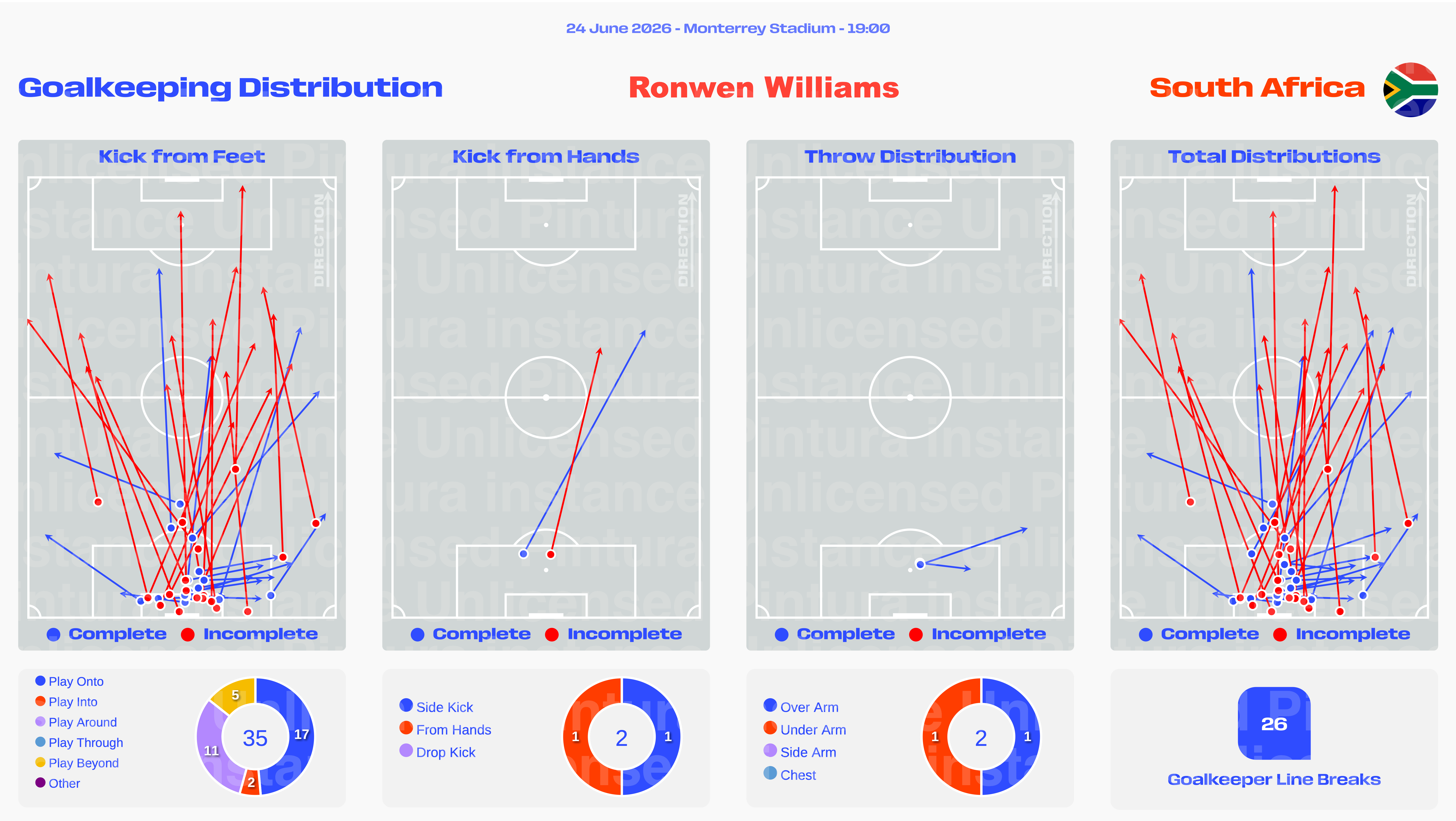
Players have always made offers to receive the ball. Now, we can measure these offers and their effectiveness. A player can have a quiet game on the ball and still be making a significant contribution off it. There is more to unpack - the location of offers, whether they lead directly to chances and goals - but that is a deeper dive for another day. If Bafana's run continues, we'll turn our attention to another FIFA metric - movements to receive.
*Data and images from FIFA Matchcentre.